






The United States offers one of the most flexible and diverse education systems in the world. Whether you’re an international student or a domestic applicant, understanding how the US education system works can make your academic journey smoother and more successful. From credit hours and GPA to choosing your majors and minors, this complete guide breaks down the key elements you need to know.
Overview of the US Higher Education System
Higher education in the US typically includes two main levels:
- Undergraduate Programs (Associate or Bachelor’s degrees)
- Graduate Programs (Master’s and Doctoral degrees)
US universities are known for offering flexibility in course selection, interdisciplinary learning, and opportunities to tailor your studies based on personal and career goals.
What Are Credit Hours?
Definition:
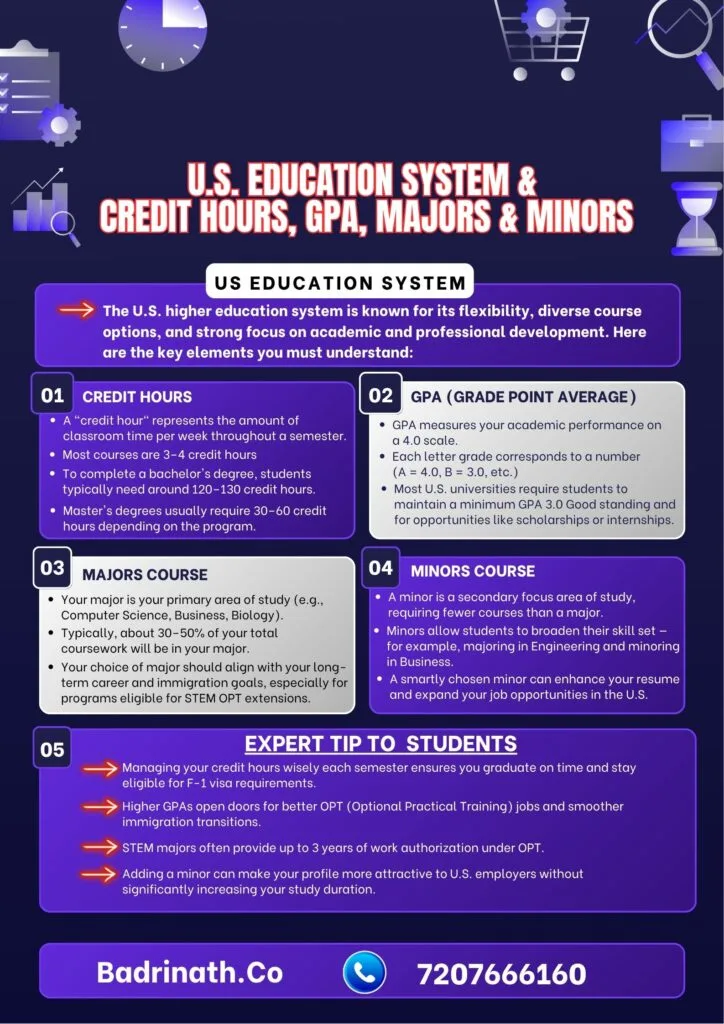
Credit hours represent the number of hours a student spends in class per week during a semester. They are used to measure academic progress and course load.
How They Work:
- One course usually equals 3 credit hours
- A typical full-time student takes 12–15 credit hours per semester
- Bachelor’s degree typically requires 120–130 credit hours to graduate and also
- Master’s degrees usually require 30–60 credit hours
Each university sets its own requirements, but you’ll need to complete a set number of credit hours in both your major and general education subjects.
Understanding GPA (Grade Point Average)
What is GPA?
GPA is a numerical representation of your academic performance, typically on a 4.0 scale. Each grade you earn in a class has a corresponding point value:
| Grade | Meaning | Points |
| A | Excellent | 4.0 |
| B | Good | 3.0 |
| C | Average | 2.0 |
| D | Below Avg. | 1.0 |
| F | Fail | 0.0 |
Your GPA is calculated by multiplying the grade points by credit hours and then averaging them.
Types of GPA:
- Cumulative GPA: All courses across your academic program
- Major GPA: Courses specifically within your major
- Semester GPA: GPA for a particular semester
A high GPA is often required for scholarships, graduate school admission, and job placements.
What Are Majors and Minors?
In the US, students can customize their education by selecting majors and minors.
Major:
Your major is your primary field of study. It includes a set of required courses that provide in-depth knowledge in one discipline.
Examples:
- Computer Science
- Business Administration
- Psychology and also include
- Engineering
Most bachelor’s programs require 30–50 credit hours in your major.
Minor:
A minor is a secondary area of study that complements your major. It usually requires fewer credits (15–20 credit hours).
For example:
- Major in Biology, Minor in Chemistry
- Major in Economics, Minor in Political Science
Choosing the right minor can make your degree more versatile and attractive to employers.
General Education Requirements
In addition to your major and minor, you’ll need to complete general education (Gen Ed) courses. These cover a broad range of subjects such as:
- English Composition
- Mathematics
- Natural Sciences
- Social Sciences
- Humanities
The idea is to produce well-rounded graduates with strong communication, critical thinking, and problem-solving skills.

Electives and Flexibility
One of the biggest advantages of the US education system is its flexibility. Besides required courses, you can take elective courses in any subject that interests you—art, music, entrepreneurship, or even sports management. However electives allow students to explore different fields and discover new passions that might lead to a double major or a career shift.
Academic Calendar
Most US universities follow either a semester system (Fall and Spring semesters) or a quarter system.
- Semester: Two 15–17 week terms (Aug–Dec and Jan–May)
- Quarter: Four 10-week terms (Fall, Winter, Spring, Summer)
Some institutions also offer Summer sessions for short courses or to catch up on credit hours.
Graduation Requirements
To earn a bachelor’s degree, you typically need to:
- Complete the required credit hours
- Maintain a minimum GPA (usually 2.0 or higher)
- Fulfil general education, major, and possibly minor requirements and also
- Pass any capstone projects or senior theses, depending on your major
Graduate programs often require fewer credit hours but include thesis, research, or internship components.

Conclusion
In conclusion understanding the structure of the US education system—from credit hours and GPA to majors and minors—is essential for academic success. Whether you’re just beginning your undergraduate journey or planning to transfer from another system, knowing how these components work will help you make smart, strategic decisions.
The US system offers the flexibility to personalize your education, explore multiple interests, and align your studies with your long-term career goals.
Read More About the Topic
External Links
Your Complete Guide to the US Grades System
American Education and Higher Ed System: The US Education System Explained
Internal Links
Top 10 Mistakes Students Make When Planning to Study Abroad
How to Write a Winning Statement of Purpose (SOP) for US Admissions?