






High-caliber experts in science, research, or other fields can remain in the United States with the help of the EB-1 and EB-2 immigrant visa categories. These visa categories are designed especially for highly qualified scientists, researchers, and people with advanced degrees or notable accomplishments.
In essence, this page gives a thorough rundown of the EB-1 and EB-2 visa categories, outlines the prerequisites for each, identifies the distinctions, and gives information on how eligible researchers can apply for these green card possibilities.
Explanation of the EB-1 Visa Category
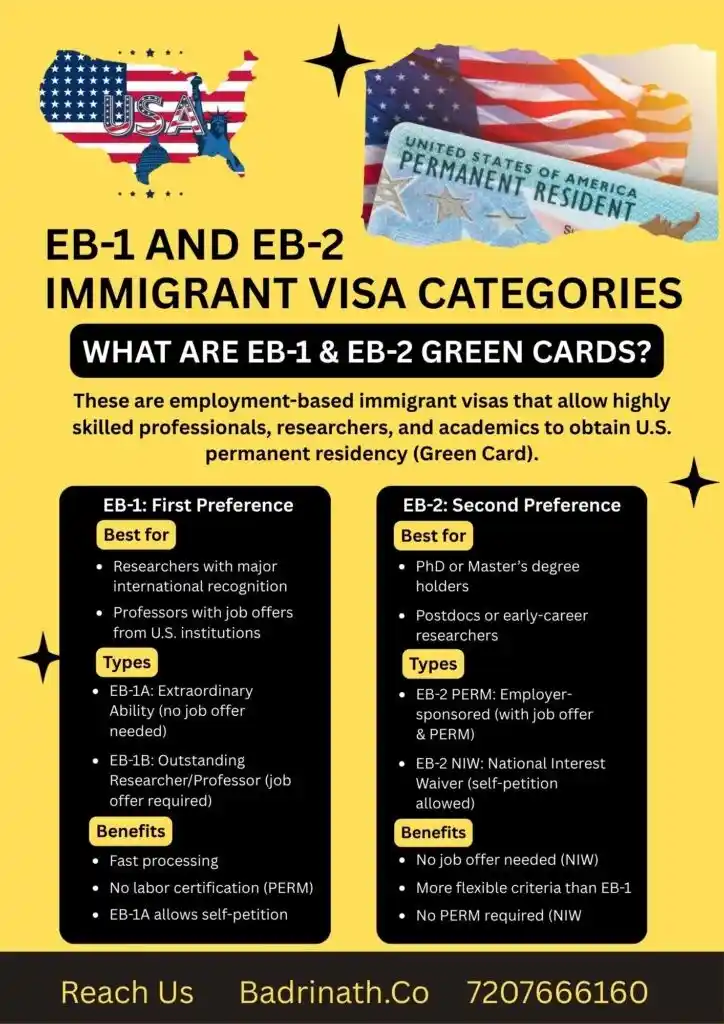
However, exceptional professors and researchers, international executives or managers, and those with exceptional talent are the only ones eligible for the EB-1 visa (Employment-Based First Preference). Since it is most pertinent to researchers, we will concentrate on the EB-1B subcategory for the purposes of this paper.
EB-1B for Exceptional Researchers and Professors
The EB-1B visa is often intended for people whose scholarly contributions have earned them international prominence. Because of its high preference level, this immigrant visa enables qualified applicants to receive a U.S. green card more quickly than most other categories.
Researchers’ EB-1B Requirements
In order to be eligible for the EB-1B category, a researcher needs to:
- possess a minimum of three years of academic teaching or research experience.
- First, obtain recognition for exceptional efforts on a global scale.
- First, receive recognized on a global scale for exceptional contributions to a particular field of study.
- possess a job offer from a U.S. employer (often a university or research institution) for a tenured, tenure-track, or permanent research employment.
Additionally, the candidate needs to submit a minimum of two of the following:
- prestigious honors or prizes for exceptional performance.
- participation in organizations that demand excellence.
- other people’s published works that discuss the applicant’s work.
- involvement in evaluating the work of others.
- original scholarly or scientific works.
- academic book or article authorship.
Explanation of the EB-2 Visa Category
People with advanced degrees (Master’s, PhD, or equivalent) or those with extraordinary talent in the business, arts, or sciences are typically eligible for the EB-2 visa (Employment-Based Second Preference). The National Interest Waiver (NIW) is a useful subclass of EB-2 that attracts highly qualified scholars in particular.
EB-2 prerequisites
Within the EB-2 category, there are two routes:
Labor Certification on Standard EB-2 (PERM):
requires a U.S. company to extend a job offer.
requires a certification from the Department of Labor stating that there are no available qualified U.S. workers.
National Interest Waiver, or EB-2 NIW:
does not need a labor certification or a job offer.
In general, candidates need to show that their activity serves the interests of the United States as a whole.
NIW Standards for Investigators
Lastly, in order to be eligible for a National Interest Waiver, researchers need to demonstrate:
Their efforts are of national significance and have great merit.
They are also in a good position to further their work.
Waiving the typical labor certification and job offer requirements, however, is advantageous to the United States.
Additionally, this renders the EB-2 NIW
EB-1 vs EB-2: What’s the Difference?
| Feature | EB-1 (EB-1B) | EB-2 (NIW) |
| Priority Level | First preference | Second preference |
| Processing Time | Generally faster | It may be slower depending on the country |
| Job Offer | Required | Not required (NIW) |
| Labor Certification | Not required | Not required (NIW) |
| Criteria | Higher bar: “Outstanding” recognition | Lower bar: “National interest” and “well-positioned” |
Both options are highly competitive and require strong documentation, but EB-1 typically requires a more extensive track record of accomplishments.
How to Apply for an Immigrant Visa (EB-1 or EB-2)
1. Establish Eligibility
Examine your work experience, research accomplishments, and academic background.
- Get the petition paperwork ready.
- Good documentation is essential. Incorporate:
- CV providing a thorough overview of one’s professional and academic background.
- letters of recommendation from subject-matter specialists.
- citations, impact evidence, and published research publications.
- Evidence of peer review positions, memberships, and honors.
3. Submit Form I-140 (Alien Worker Immigrant Petition).
This form usually starts the green card application process. Employer sponsorship is required for EB-1B, although the applicant may petition for EB-2 NIW.
4. Status Modification or Consular Procedure
You can file Form I-485 (Adjustment of Status) if you’re in the United States or finish consular processing if you’re overseas after the I-140 is authorized and your priority date is up to date.

The Benefits of EB-1 and EB-2 for Researchers
- Researchers benefit greatly from these visa categories since they:
- Establish a route to long-term residence.
- Acknowledge scholarly and scientific excellence.
- (EB-2 NIW) Permit self-petitioning.
- Save time by avoiding labor certification.
Concluding remarks
Excellent chances for highly qualified researchers to get permanent residency in the United States are provided by the EB-1 and EB-2 immigration visa categories. However, your academic background, accomplishments, and professional objectives will determine which option is best for you.
Let’s say you have a solid academic background and are a PhD graduate or foreign scholar. If so, it might be worthwhile to investigate your eligibility for an EB-1B or your ability to successfully self-petition under the EB-2 NIW route. Additionally, You can improve your chances of approval and customize your approach by speaking with an immigration lawyer.
Important Takeaways:
- Internationally renowned researchers with job offers are most suited for EB-1.
- Self-petitioning is permitted under EB-2 NIW for those whose labor helps the United States.
- Lastly, there are direct routes to a green card for both visa classifications.
Keywords:
- EB-1 and EB-2
- Immigrant visa
- EB-1 and EB-2 visa
- NIW
- Apply for green card
- Requirements for researchers
- Employment-based immigration
- EB-1 and EB-2 NIW
Read more about the topic
External Links
EB1 vs EB2: Which Visa is Right For You?
Internal Links
Timeline Differences Between EB-1 and EB-2 NIW
Approved EB-1 and EB-2 NIW Petitions from Academic Researchers